
In our previous blog account, we described the villages in the Galilee, where the Tarajmeh ancestors lived and examined the geographical settings of their communities, close to the trade routes, and near the farmlands of Sahil al-Battouf, with its neighbouring villages of Sakhnin, Arraba, Deir Hanna and Cana. We also discussed the potential reasons that may have influenced their choice of these locations. In this blog, the story moves from geography to family: discussing their marriages, relationships, alliances, and the cultural world in which their descendants lived.
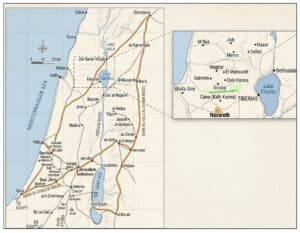
Image modified from Farming in Galilee Map (https://www.casualenglishbible.com/wp-content/uploads/2021/12/matthew-9-galilee-farming-1200px-1.webp) and from Image of the Roads from Gaza to al-Karak (in The Gaza- Damascus Roads in the Medieval Periods by Fawzi Zayadine (https://publication.doa.gov.jo/uploads/publications/24/SHAJ_9-367-378.pdf

Marriage was an important means through which families established lasting relationships and strengthened their position within their individual communities. The ancestors appear to have entered into marriages with established Christian families of the Galilee, including families belonging to local social and economic elites. Such unions may have beenmotivated not only by affection and kinship, but also by commercial interests and the creation of alliances between families engaged in trade and other forms of business. Over successive generations, some branches of these families appear to have risen in social standing, with descendants eventually acquiring titles such as Sheikh and Emir.
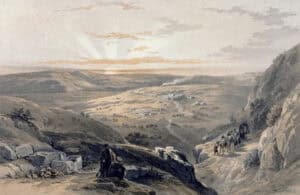
Image: View of Cana, Galilee by David Roberts. From: https://world4.eu/cana-galilee/#lightbox-gallery-0/1
A Multilingual World
The linguistic environment of the period was remarkably diverse. The ancestors would have encountered communities speaking Arabic, Aramaic, and Greek, among other languages. Greek had a particularly important historical presence in the eastern Mediterranean and remained influential in the Christian communities of Greater Syria for centuries. It was also the language associated with the Byzantine world, whose cultural and political influence extended beyond Syria into parts of southern Italy, including Campania, Puglia, Basilicata, and Calabria.
It is therefore possible that Greek served as an important language of communication with portions of the local Christian population of Syria and especially in northern Palestine, when they arrived c. 1050. At the same time, Aramaic continued to be spoken to a lesser extent in communities throughout the region, and after they lived in Palestine Arabic language increasingly became an important language of everyday life. The ancestors’ names provide another indication of this complex cultural environment.
Arabic and Latin Names
One distinctive feature of these families was the use of both Arabic and Latin or Christian names. Within their wider communities, individuals could be known by their Arabic names, while Latin or Christian names were used within family, ecclesiastical, or other Christian contexts. This dual naming tradition reflects the cultural intersections that characterized the eastern Mediterranean.
Among the men’s names were several drawn from the Bible and Christian tradition. These included Daud (David), Musa (Moses), Mika’il (Michael), and Jibrail (Gabriel). Other names included Merhi and Najm, the latter associated in the family tradition with the Latin name Hugh. Mansour may have carried a geographical association with al-Mansoura, while Na’aman was associated with the river of the same name or a biblical name.
One particular ancestor name has been past down through oral history, Na’aman nicknamed Biran. Na’aman lived for some time around the area of Jaffa, he was a trader, a worrier and had three wives. His first wife was called Tecla from Tyre, they had one son called Najm. Na’aman’s second wife was called Hind and was from Galilee, he married after the death of Tecla. They had four sons together, Musa and Merhi who lived in Jaffa and reported to have both died young, while Mika’il (Michael) and Jibrail (Gabriel) lived in Galilee, after the death of Hind. Na’aman married a Flemish woman named Helvis during the crusade period in the first half of 12th century period. With Helvis they had two sons and two daughters from her, their names and history will be discussed later.
While in Palestine, in 11th century before the crusade period the men married women from Horan, Galilee and on occasions from Tyre. Some of the daughters married Italians, we presume some were traders from South of Italy, as we can see later. The female names of the wives of the ancestors husbands, reveals the blending between Arabic, Greek and Latin Christian names, adopted by Christian families in Greater Syria at the time. Among those names were Laila, Tecla, Hind, Rawan were names of the wives of some Tarajmeh ancestors while some of the daughters names were Thurraya/Soraya, Karima, Mariam, the latter corresponding to Maria.
Laila is an Arabic name, indicating that Arabic naming traditions had become established among at least some Christian families Arabic-speaking Christians also used Arabic personal names. Hind is a particularly interesting name as It has pre-Islamic Arabic associations and was used among Arab groups such as the Ghassanids, including Christian Arabs. Its presence could therefore reflect the persistence of an older Arab cultural naming tradition within Christian communities.
Tecla (Thekla) comes from the Greek Christian tradition. Its presence points toward the strong influence of Greek Christianity in Syria and Palestine, particularly given the historical importance of Greek-speaking ecclesiastical culture.
Rawan Arabic name conveys vitality, inner purity, and graceful motion like flowing water. It was used by Christians in the area of Horan, persumambly linked to Ghassanids tribes.
Mariam/Maryam illustrates another layer. The name ultimately corresponds to the biblical Mary/Maria, but Maryam was also deeply established in Arabic and Syriac-speaking Christian communities. Mariam married an aquiantance of Sabinus named Alessandro.
Soraya/Thurayya is associated with the Arabic name for the Pleiades (the star cluster). Its use indicates that Christian women could also bear names originating in the broader Arabic cultural environment rather than exclusively biblical or ecclesiastical names. Soraya married an Italian from Bari, called Sabinus.
The strongest conclusion from these names is that these families were probably part of the indigenous Christian population of Greater Syria that had become culturally Arabized while remaining Christian. This is particularly significant for the 11th century because, by then, Arabic had become an important language of Christian life in much of the Middle East, even though Greek and Syriac remained important in communities and religious contexts.
Marriage and the Mediterranean Connection
The marriages remembered in the family tradition also point toward connections extending beyond the immediate villages of the Galilee. One notable example is Thurayah/Soraya, as pointed out earlier, who married a trader from Bari in southern Italy, called Sabinus. The name Sabinus is after the sixth century Saint Sabinus of Bari, who the family supported in his trade venture, he was reported to have been tall, strong and a great fighter.
According to the family account, her husband subsequently settled in Palestine. His origins in Bari are particularly significant because Bari was an important port and commercial centre of the Adriatic and Mediterranean worlds. The movement of merchants between southern Italy and the eastern Mediterranean was part of a much broader network of trade, pilgrimage, and cultural exchange.
Thurraya/Soraya marriage therefore represents more than a union between two individuals. It illustrates how commercial networks could bring together families from distant shores. A merchant arriving from Bari could establish himself in Palestine, marry into a local Christian family, and become part of the society in which he settled.
Another relationship preserved in the tradition concerns Alessandro, a friend of Thurraya’s/Soraya‘s husband, who married Mariam( Maria). Such marriages suggest that personal relationships among merchants could also lead to connections with local families. Trade and marriage consequently became intertwined, creating networks that crossed geographical and cultural boundaries.
Names Preserved Through the Generations
The names preserved among the ancestral clans provide another glimpse into this multicultural society. Alongside Arabic names were names such as Evelina, Marguerita, Andrea, George, Peter, and Saverio. These names belong to a wider Christian and Mediterranean naming tradition Italian and Christians in Plaestine and, taken together with the Arabic names, suggest that the families inhabited a cultural world in which identities were not confined to a single linguistic tradition.
The presence of names associated with Italy is especially noteworthy when considered alongside the tradition of a trader from Bari settling in Palestine. It suggests that the family’s history was connected not only to the villages of the Galilee but also to the maritime routes linking Palestine with southern Italy.
Relatives’ names associated with the Ancestors
In the 12th century, ancestors lived in areas such as Mi’ilya in north Galilee, oral history remembers one particular family member ‘Uncle’ Henry known also as Abdullah among his family, who is reported to have liked to drink wine. The wine was obtained from vinyards in the valley close to Mi’ilya from Tarshiha village area. His brother was known as Fares (Philip). Henry had four daughters called Sybilla, Helvis, Agnes and Stephanie. Although sisters they had different physical characteristics, as Sybilla was said to be a tall and beautiful woman, while Agnes was said to be wealthy, but plain and overweight and had a darker completion than her sisters skin. Sybilla was said to have died at an early age. Stephanie married an Italian lord from Byblos, Lebanon.
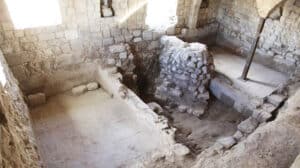
Image: Crusader-Era Winery in Mi’ilya- Two treading floors allowed the locals to crush their grapes after harvest. (Courtesy of Dr. Rabei Khamisy, Zinman Institute of Archaeology, University of Haifa) from https://www.winespectator.com/articles/chance-discovery-of-unprecedented-crusader-era-winery-reveals-new-insights
Also, the ancestors had relatives in Tiberia some the names narrated are Eschiva, Helvis, Rauol and Elias. Rauol was held in high esteem by the ancestors, Elias had a weak personality. Other names will be presented and discussed in the future. In additions, they had relatives lived in Tyre, Baisan, Byblos, Beirut and Batrun.
Family, Faith, and Social Mobility
The preference for large families would have strengthened these networks over generations. Each marriage could create new bonds between households, while children carried the relationships into the next generation. Through marriage, commerce, and inheritance, families could gradually expand their influence and social connections.
The reported intermarriage with prominent Christian families of the Galilee was therefore an important factor in the family’s social development. Commercial alliances became family alliances, and family alliances, over time, contribute to social advancement. The later appearance of titles such as Sheikh and Emir in some branches of the ancestry may reflect this gradual process of integration and rising status in the Galilee, although the precise circumstances behind these titles would require documentary evidence.
Taken together, the marriages and names of the Tarajmeh ancestors reveal a society shaped by movement and interaction. Arabic, Aramaic, Greek, and Latin-Christian traditions existed alongside one another. Families of the Galilee formed relationships with merchants arriving from western Mediterranean, specifically Italy, while marriages linked local households to wider commercial networks. The result was an ancestry that was simultaneously local and western Mediterranean.
Their story is therefore not simply the history of individual families living in villages. It is also the story of cultural exchange, marriage alliances, commerce, language, and social mobility in the eastern Mediterranean. Through their marriages and the names passed down through the generations, we can glimpse a world in which identities overlapped, and families could maintain several cultural traditions at once. They were already from an elite family line in Italy, and formed the nucleus of a noble line heritage in Palestine.
What we undestand that from these marriages, mixed culture was united under the platform of Christianty, and surrounded by the Seljuks who identified themselves as Sunni muslims, and the Fatimids who identified themselves as Shiite muslims.
The Amalfitans and other Italian traders operated within an existing Christian and commercial environment in Jerusalem, to enable them building the church St Maria of Latinas in Jerusalem and a hospice for the pilgrims. The presence of Italians in Jerusalem and being involved in eccelestic, pilgrims and trade in Palestine, and the creation of a market in Jerusalem.
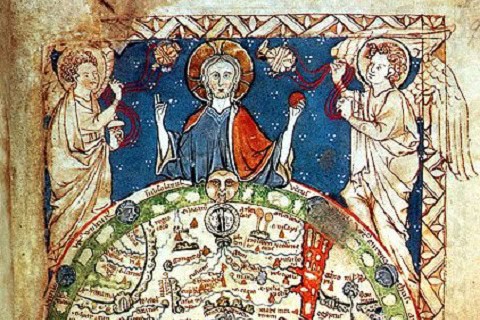
Blog 6 Image of Psalter map (Londoner Psalterkarte): A map of the world, with Jerusalem at the centre and the monstrous races on the outermost edge. London BL: Additional Ms. 28681 fol-9r detail.(from: https://commons.wikimedia.org/wiki/Category:Psalter_world_map_London#/media/File:Psalter_world_map.jpg)
