

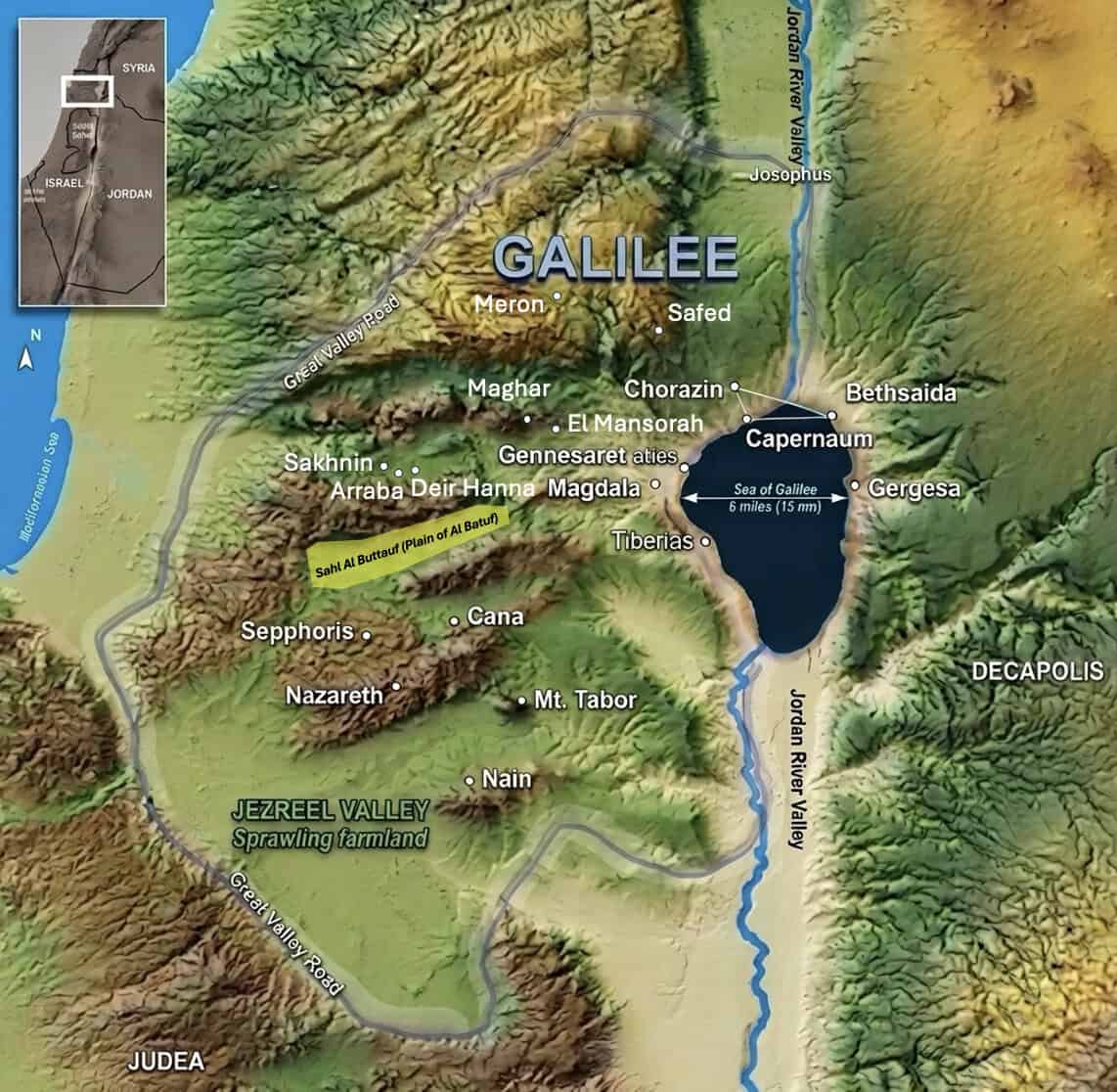
Galilee, the region of northern Palestine surrounding the Sea of Galilee, played an important role in the political, religious, and economic history of Bilad Al Cham (Greater Syria) during the medieval period. Between the seventh and twelfth centuries AD, Galilee experienced major political changes as control passed from the Byzantine Empire to Muslim rulers and, later, to the Crusaders. Despite these changes, the region remained an important agricultural area and a meeting place for different religious and cultural communities. Its towns, villages, agricultural lands, and religious sites connected Galilee to the wider political and commercial networks of Syria and Palestine.
During the seventh and eighth centuries, Galilee benefited from its location between the major centres of Syria and Palestine. One of the most significant cities in the region was Tiberias, located on the western shore of the Sea of Galilee. The city had already been an important centre during the Byzantine period and continued to prosper under Muslim rule. It became the capital of the military-administrative district known as Jund al-Urdunn, or the military district of Jordan.
Tiberias was important both politically and economically. Its location on the Sea of Galilee supported fishing, agriculture, trade, and crafts. The surrounding countryside was productive, with crops including olives, grapes, and grains. Agricultural production in the region helped sustain the urban population and contributed to the wider economy of Palestine.
The Tenth and Eleventh Centuries
The political situation in Palestine became increasingly unstable from the tenth century onwards. The Abbasid Caliphate gradually lost effective control over many areas, while rival Muslim dynasties competed for influence in Palestine and Syria.
Galilee was particularly affected by the rise of the Fatimid Caliphate, which conquered Egypt in 969 AD and extended its authority into Palestine. The Fatimids, who were Ismaili Shi’a Muslims, controlled the region for much of the late tenth and eleventh centuries, although their authority was periodically challenged.
During this period, the Fatimids developed important commercial relationships with merchants from the Mediterranean. Among these were traders from the Italian city of Amalfi, in southern Italy. Amalfitan merchants established a presence in Egypt, particularly in Cairo and Alexandria, where they maintained commercial communities and warehouses. At one point, reports suggest that there may have been as many as 200 Amalfitan merchants in Cairo.
It is important to note, however, that the term “Amalfitan” may not have referred exclusively to people from the city of Amalfi. Historical accounts indicate that merchants from other Italian cities, including Salerno, Bari, and Pisa, were also active in these commercial networks. The prominence of Amalfi and the trading privileges granted to its merchants, possibly including tax concessions, may have resulted in other Italian traders operating under the same commercial identity or privileges.
The relationship between the Italian merchants and the Fatimid authorities had already developed before the Fatimids transferred their centre of power from Tunisia to Egypt. The Fatimids had ruled from al-Mahdiya in Tunisia before establishing their new capital, Cairo, in 969 AD. The commercial links established during the Tunisian period subsequently continued and expanded under Fatimid rule in Egypt and Palestine.
Italian Merchants in Palestine
During the eleventh century, Italian merchants from Amalfi expanded their commercial activities into Palestine. They appeared in Jerusalem alongside merchants from Bari, Salerno, and other Italian cities. The Italian presence in Jerusalem grew significantly, particularly from the middle of the eleventh century.
The merchants established commercial and religious institutions, including Santa Maria Latina, a church and hospice associated with Italian merchants and pilgrims. Such institutions provided accommodation and services for Western Christian pilgrims travelling to Jerusalem. The Italian communities included not only merchants but also people with other professions, including architects, doctors, and priests.
By the middle of the eleventh century, an established Italian community existed in Jerusalem. Trade and pilgrimage increased during the period before the Seljuk expansion into Palestine in the late eleventh century. To support this expanding commercial activity, Italian merchants also established warehouses and trading facilities at important Mediterranean ports, including Acre and Jaffa.
The combination of trade, pilgrimage, and maritime connections created a network linking southern Italy with Egypt, Palestine, Syria, and the wider Mediterranean world. It is within this historical environment that the arrival of the ancestors of the Tarajmeh family in Palestine can be considered.
The Arrival of the Tarajmeh Ancestors
The Tarajmeh oral tradition is woven throughout this regional history, in that our ancestors have been among the Italian merchants or people associated with these Italian commercial communities who travelled from southern Italy to Palestine during the eleventh century.
One possible reason for their movement from southern Italy was the increasing political and military instability in the region. Southern Italy during this period was affected by competition between the Normans, Byzantines, and Lombard principalities, particularly those associated with Benevento and Salerno. These political struggles, together with expanding commercial opportunities in the eastern Mediterranean, may have encouraged some individuals and families to seek opportunities abroad.
According to this assessment, the Tarajmeh ancestors arrived in Palestine through the commercial networks connecting southern Italy with Egypt, Jerusalem, and the ports of Palestine. The documented oral history, says they initially established themselves in Jerusalem and the wider Galilee region.
They subsequently became integrated into the local population and is particularly important to our story, they married women from elite of the Galilean communities, maybe to form trade alliances, and gradually established permanent family connections in the region. Over time, such integration transformed a group of foreign merchants or migrants into an established local clan.
In our reconstruction of the history with the information available we believe they first settled in the village of al-Mansurah (El-Mansorah), a village situated near important routes connecting Damascus with the ports of Acre and Tyre to the north, and extending southwards towards Jaffa, Gaza, and ultimately Cairo. This location would have been advantageous for people whose origins were connected to trade. The road was subject to attacks after the rise in bandit activity and the arrival of new Turkic nomad tribes. This occurred during the period when the Seljuks grip on Syria and Palestine started to become weaker due to wars with the Fatimids and internal competition.
The Move towards Cafer Cana and Sakhnin–Arraba–Deir Hanna Area
After further analysis of Tarajmeh clan ancestors’ oral and written history, we discover they owned land in the Christian majority areas surrounding Cafer Cana and the three villages of Sakhnin, Arraba, and Deir Hanna. Oral history says that they owned land within in area of these villages.
One possible explanation for this movement is the increasing instability that followed the expansion of Seljuk power into Palestine in the late eleventh century. The Seljuk takeover of Jerusalem and other areas changed the political and security environment of the region. The attack on Tiberias in 1076 by Atsiz ibn Uvaq, the Seljuk-Turkic ruler who controlled parts of Palestine, was another significant event in the history of the area.
Tarajmeh ancestors who were living in Al Mansoura reported that they fought against Bedouins and Turkic tribes and hid in the nearby caves of Maghar. The village of Al Mansoura is located at 15 Km distance from Sakhnin and near the commercial routes at this time, the political instability may have encouraged them to move to safer or more economically advantageous locations further inland. Al Mansoura village was destroyed by Israel in 1948.
The villages of Sakhnin, Arraba, and Deir Hanna were situated relatively close to Tiberias and near the fertile area Sahl al-Buttauf, or the Plain of Batatuf. This was an important agricultural region and provided favourable conditions for permanent settlement.
The location would have offered several advantages. It was close enough to Tiberias and the surrounding commercial routes to maintain access to trade, at the same time it surrounded with agricultural land suitable for farming. The area at the time and continues to this day, was particularly productive for the cultivation of wheat, barley, and grapes, and made it an attractive location for clan members transitioning from a commercially oriented life towards a more settled agricultural existence.
The Strategic Importance of Galilee
The Galilee carries deep Canaanite roots, stretching back to the Bronze and Iron Ages. Settlements like Tel Hazor, Tel Megiddo, and Tell Dan were founded during this period. Cafer Cana was one of these Canaanite cities. Pottery unearthed there in 2014 confirmed it. This is the same town where Jesus reportedly turned water into wine. Sakhnin began as a Canaanite settlement around 3,500 years ago. By antiquity it had grown into a major center for purple dye production in the region. Arraba developed alongside it, founded as a neighboring Canaanite settlement in that same era. The Tarajmeh ancestors settled in this same area of Galilee, amid trade routes, farmland, and shifting borders that shaped Palestine through the medieval period.
This area had several distinct geographic advantages. Positioned just inland from Tiberias, a principal administrative and commercial hub, it sat directly on vital trade arteries running to Acre, Tyre, Jaffa, Gaza, Damascus, and Cairo. Surrounding the settlement, the fertile agricultural expanse of the Plain of Battauf supplied the crop yields needed to sustain permanent habitation across the centuries.