
The Tarajmeh clan’s ancestors arrived in the Holy Land from Southern Italy around the mid-11th century, carrying Tuscan roots with them. Over the next decades they built a life across Galilee’s mountains, Jaffa’s ports, and Jerusalem’s streets, working as traders, soldiers, and believers trying to survive a region in constant upheaval.
Family tradition holds that the earliest Tarajmeh forefathers allied with local Ghassanid tribes in Hurran and Golan. They traded with these Arab Christian tribes and married their daughters, ties that shaped the family for generations after.
The three decades before the First Crusade were some of the most violent in Palestine’s history. Between 1060 and 1099, Bedouin raiders hit trade caravans, the Seljuks invaded Palestine in 1071, and the Fatimids fought to hold the region. The Great German Pilgrimage of 1064-1065 brought between 7,000 and 12,000 Christians from Germany to Jerusalem, led by Archbishop Siegfried I of Mainz and Bishop Gunther of Bamberg. Near Ramla in 1065, the pilgrims came under heavy attack, and the group returned home with heavy losses.
On Easter Monday of 1065 the Fatimid governor of Ramla drove off the Bedouins and freed the pilgrims, who rested in the city for two weeks. Atsyz ibn Uvaq Khorasmi the Seljuk ruler of Palestine lost his campaign against the Fatimids in Egypt in late 1076. As he retreated, the coastal towns of Acre, Tyre, and Tiberias revolted. Atsyz crushed the rebellion, executed the rebel governor of Acre, Sukli, who had fled to Tiberias, and punished the town. Then, in 1092, the Seljuk sultan Malik Shah died suddenly, and a ten-year civil war broke out as his sons and rival relatives fought over the empire. The centralized state broke apart into competing regional powers, and warlords gained ground. Pilgrims, merchants, and ordinary townspeople got caught in between.
These events shaped where the Tarajmeh ancestors settled, how they traded, and when they moved during the last quarter of the 11th century.
Their first home was the Merom area, in Upper Galilee. In the mountains and caves around Merom and Maghar, they fought off raids from nomadic Turkic tribes and Bedouin bandits. The terrain sheltered them and taught each generation of sons how to survive.
They later moved south, settling near Bethsaida (Tel et-Tell) on the Sea of Galilee’s northern shore and Al Mansura in the sub-district of Tiberias. They acquired fertile land across Lower Galilee, especially in the valleys around Sakhnin, Arraba and Deir Hanna, and these fields became the base of their wealth. This area is close to the Trade and Pilgrim roads that link Damascus to Acre, Tyre, Jaffa, Gaza and ending in Fatimid Egypt.
The clan family members then settled in Cafr Cana, known to the Romans and Crusaders as Cafran. Wealth drew rivals. During the Crusader period, they had a dispute over their land in the Sakhnin Valley with a Frankish man tradition remembers only as “the Red”, who married somebody within the family circle. They held on to both the land and their name.
The Tarajmeh clan ancestors reach went beyond Galilee. In Al-Majdal, near Ascalon, they farmed mulberry groves that fed the silk trade and orange orchards whose fruit was prized across the region. By the time of the crusades arrived in Palestine by middle 1099, three generations of the ancestors were born in Palestine. They became a large clan in number because they had large families and this allowed them to spread around Galilee, Jaffa area and Jerusalem.
Their ties with Southern Italy were maintained and crossed the sea, too. They partnered with new merchants from Amalfi and Bari, maintaining commerce links between Italy and Palestine and the Mediterranean. Through these partnerships, goods, ideas, and customs passed both ways, and the family became a bridge between the two worlds.
Some family members stayed on as landholders or merchants around Cafr Cana, Sakhnin, and Tel et-Tell (Bethsaida). Others moved to Abu Ghosh area on the pilgrims and trade road between Jaffa and Jerusalem, while some lived in Jerusalem. There they worked as physicians treating the sick, architects designing buildings, and priests serving in the city’s churches.
Some moved from the Tiberia area after the revolt against Atsyz and others lived in Cafr Cana, Abu Ghosh area near Jaffa, and Jerusalem. The next generations collaborated with Italians who were trading in Palestine who came from Amalfi, Bari, and Salerno, and some daughters married men from Bari. Others, worked as doctors, monks, and architects, organizing care for pilgrims under Gerard, the Benedictine lay brother based at the abbey of St. Mary of the Latins.
Around 1080, Jerusalem’s abbot put Gerard in charge of the Hospital of St. John, built on the site of the Monastery of Saint John the Baptist, itself raised in the 1060s next to an older hospice rebuilt in the 1020s. The Knights of St. John (also known as the Knights Hospitaller) grew out of an 11th-century hospital in Jerusalem dedicated to St. John the Baptist. The order evolved from a peaceful charitable hospice into a major military religious order during the Crusades, its rule following change from Benedictine to the Augustine rule.
There the family grew its trade network, dealing with merchants from across the Mediterranean and helping pilgrims travel safely between Jaffa and Jerusalem. Their name for hospitality and protection made them trusted guardians on that road. Italian merchants trading in Palestine likely brought this practice, working alongside the Italian church community in Jerusalem and local Palestinian Christians.
Regional land and caravan tracks running through the Upper Galilee and near Meron/Merom in Palestine remained active as local and inter-regional arteries connecting Acre, Tiberias, and Damascus.
During the 11th century, the region of ancient Meron/Merom in the Upper Galilee experienced profound political shifts under Fatimid rule after the Seljuks taken control of majority of Palestine, before the Crusaders arrival at the end of the century.
Italian merchants and traders at the time took advantage of the privileges given by the Fatimids to Amalfi under the leadership of Mauro di Pantaleone, he had six sons; Pantaleone, Giovanni, Sergio, Mansone, Mauro, and Pardo. Amalfi traded with Egypt in the 10th century and their involvement in Palestine was subsequently witnessed in the 11th century.
After the death of Mauro in 1071, his son Pantaleone followed the footsteps of his father, the business relationship of the ancestors continued with him, and the business extended across the Mediterranean. Merchants from Amalfi and Bari partnered with the ancestors of the Tarajmeh family, opening Palestine’s ports to European trade and strengthening commerce between East and West. These partnerships moved goods, knowledge, and culture in both directions, and the family stood as a link between two worlds.
The Tarajmeh ancestors lived through conflict, migration, wealth, and faith across these generations. They moved from the countywide side of Merom to the streets of Jerusalem, from the orchards of Ascalon to the markets of Jaffa, working as farmers, traders, physicians, and guardians of pilgrims’ roads. Their descendants still carry the family name today.
From a review of their history, including where they lived and traded in Galilee, we can see that they applied the experience they had gained in Italy. They chose to live close to major trade and pilgrimage routes, allowing them to benefit from the movement of people and goods. Their trading activities focused on luxury and valuable goods, while they also owned agricultural land to complement their commercial activities. They also built local alliances with the communities and families around them, including through marriage to women from the local areas where they lived and shared space.
This approach created a balanced portfolio of investments and relationships. Income came from both trade and agriculture, while local family and community connections helped strengthen their position within the areas where they operated. By diversifying in this way, they reduced their risk: if one source of income or activity was disrupted, the other could continue to provide stability and support. At the same time, these local alliances helped them become more closely integrated into the communities in which they lived and traded.
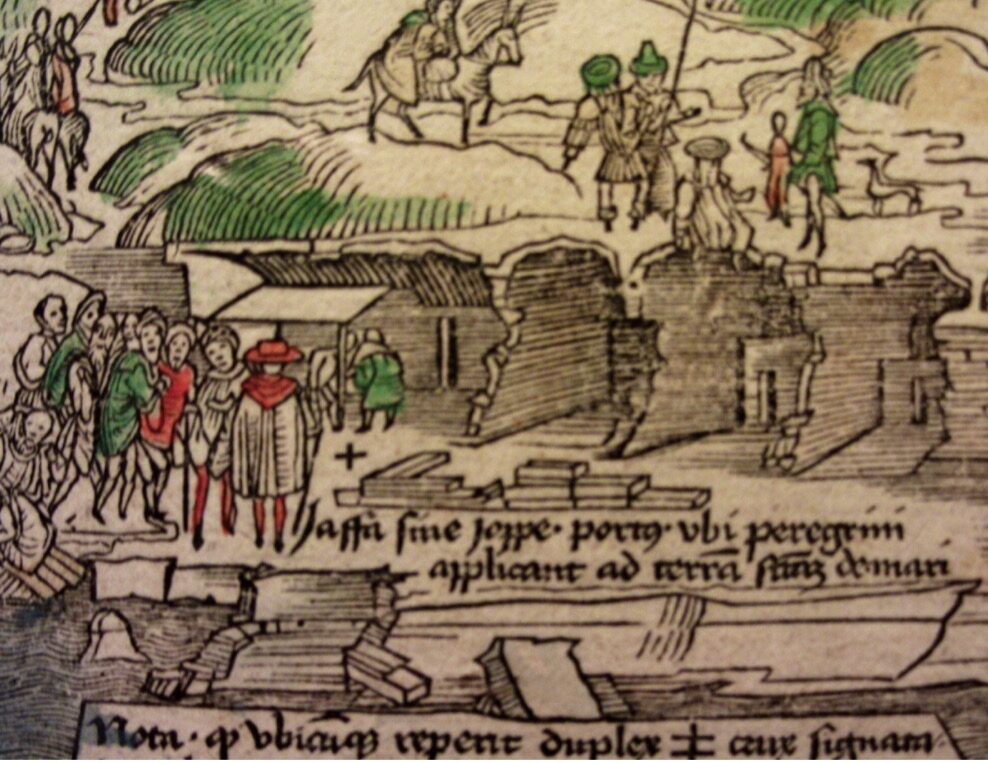
Image is of pilgrims disembarking at Jaffa amongst caves and ruins, from Erhard Reuwich’s map for Breydenbach’s guide to the Holy Land, made in Mainz, 1486